
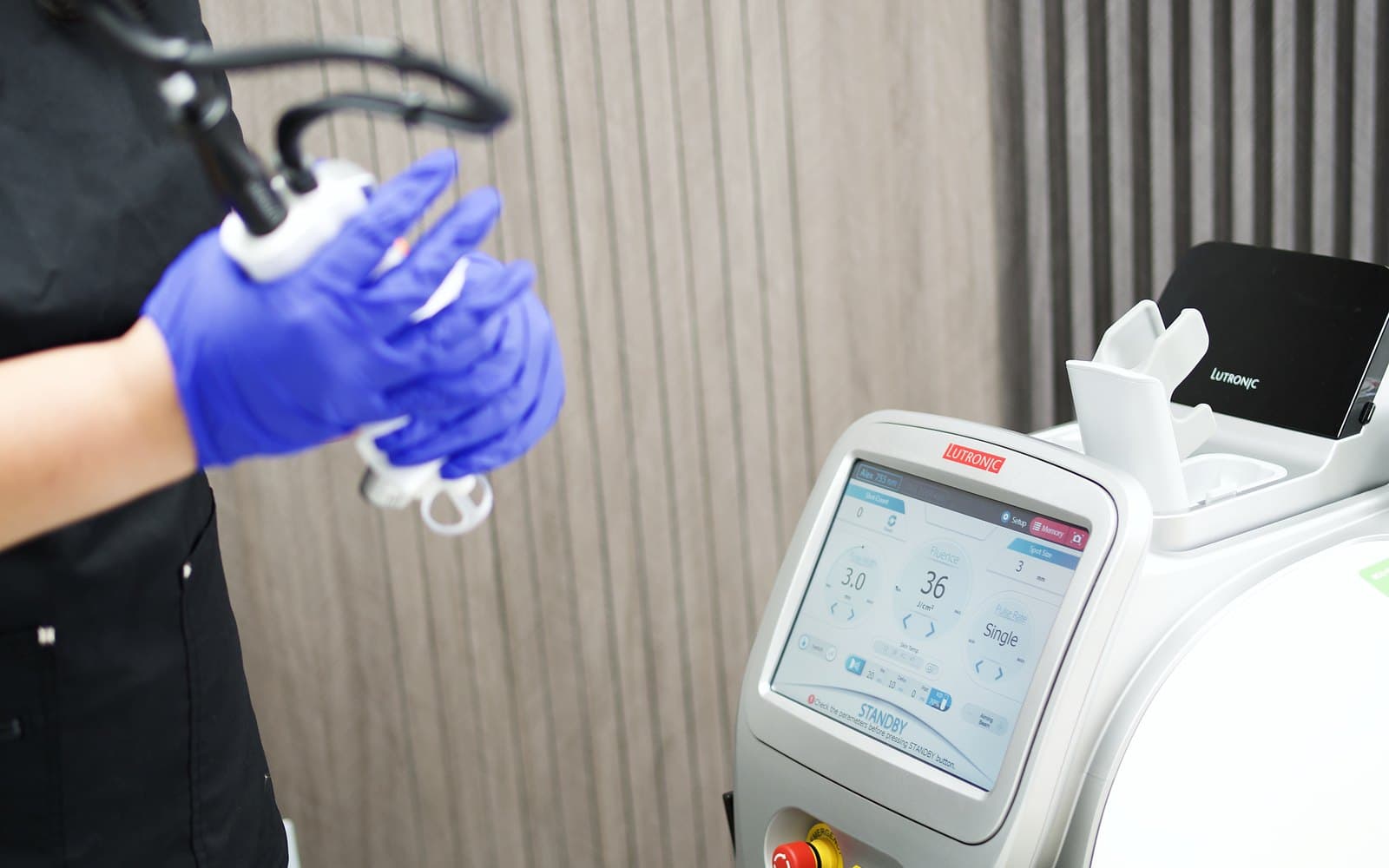
If you have shopped around for hair removal in Calgary you will have noticed that some places charge $40 for an underarm session and others charge $85, and both call it laser. Often they are not doing the same treatment at all.
One wavelength versus many
A laser emits light at a single, specific wavelength. IPL — intense pulsed light — emits a broad spread of wavelengths at once, more like a camera flash behind a filter.
That sounds like a technicality. It is not. A single wavelength can be chosen to be absorbed by one particular target — the pigment in a hair follicle, say — and largely ignored by everything around it. A broad spread of wavelengths cannot be that selective. Some of that light lands on the follicle, and the rest is absorbed by whatever else happens to be nearby, including the pigment in your skin.
Selectivity is the whole game. It decides how much energy reaches the follicle, and how much lands where you did not want it.
Why this changes your results
Because a laser delivers its energy where it is aimed, more of that energy reaches the follicle at a level that disables it. IPL spreads the same energy budget across a wider area and a wider range of targets, so less of it does the job you are paying for.
In practice this usually means IPL needs more sessions, and the results are more likely to fade. A cheaper session price can end up as a higher total.
Why it matters more if your skin is darker
This is the part that deserves the most attention. Melanin in skin absorbs light across a broad range of wavelengths. Because IPL delivers a broad range, more of that energy is absorbed by the skin itself rather than by the follicle. On darker skin tones that raises the risk of burns and pigment changes, which is why many clinics simply decline to treat deeper skin tones with IPL.
Longer wavelengths pass more safely through melanin. The Clarity II platform we use is dual-wavelength — 755nm and 1064nm — and the longer 1064nm wavelength is what makes it appropriate for darker skin tones. It is not a marketing line; it is the specific reason the machine can treat skin that an IPL device should not.
How to tell what a clinic is actually using
- Ask for the platform by name, not the category. "Laser" is not an answer; "Clarity II" or "Soprano" or "GentleMax" is.
- Ask what wavelength or wavelengths it runs at. A laser has a specific number. An IPL device has a range.
- Ask whether they treat your skin tone with it, and what happens if they judge it unsuitable.
- Be wary of prices far below the local range — that gap usually reflects the equipment, not generosity.
Is IPL always the wrong choice?
No. IPL has genuine uses, particularly for certain pigmentation and redness concerns, and in trained hands on appropriate skin it can work well. The problem is not IPL itself — it is IPL sold as laser, at laser expectations, to people whose skin tone makes it a poor fit.
Whatever you choose, you should know which one you are getting before you book. If a clinic will not tell you plainly, that in itself is the answer.
Common questions
- Is IPL the same as laser hair removal?
- No. A laser emits a single specific wavelength of light, while IPL emits a broad range of wavelengths at once. The single wavelength is far more selective, which affects both results and safety.
- Which is better for dark skin, laser or IPL?
- A laser with a long wavelength. Melanin absorbs broad-spectrum light, so IPL carries a higher risk of burns and pigment changes on darker skin. The 1064nm wavelength on a dual-wavelength laser passes more safely through melanin.
- Why is IPL cheaper?
- The equipment costs less and sessions are often shorter. But because IPL is less selective it usually needs more sessions and results fade more readily, so the total cost of a course can end up higher.
- What laser does LaserPeak Spa use?
- The Clarity II, a dual-wavelength platform running at 755nm and 1064nm, which allows us to treat both light and dark skin tones.
Most Calgary clinics quote a single number and leave out how many sessions you need. Here is the full price list, the realistic session count, and what the total actually comes to.
Redness that does not fade is not something you have to live with, and it is not something makeup solves. Here is what laser treats, what it does not, and what to expect.